
Defining Data Accounting
A systemic approach: Why we need it. What it is, how it works.

Introduction
While accounting is well-established in finance, enabling a global economy and trade, it is not well-established for data, leading to trust and sense-making challenges due to manipulated, altered, or forged information. Consequently, verifying information incurs significant time and financial costs.
Establishing trusted transactions across organizational boundaries remains a significant cost factor. For example, in the banking sector, the exchange of Know-Your-Customer (KYC) data has necessitated custom solutions, such as the SWIFT KYC Registry. This is true for organizations and individuals which like to collaborate a like.
The first distributed network to account for financial data was blockchain technology, exemplified by Bitcoin (Nakamoto, 2008). Ethereum extended this model to allow for Turing complete computation with the Ethereum Virtual Machine (EVM) and programmable Smart Contracts (Buterin, 2013). Both Bitcoin and Ethereum are fully trustless, fully accounted systems, ensuring data integrity and authenticity without reliance on intermediaries.
However, blockchains are inherently unsuited for general data accounting due to high costs, scalability limitations, and lack of privacy.
A post-blockchain system is required to account for all data, addressing scalability, privacy, and cost. Such a systemic approach must be free by default, requiring no tokens for use.
It must also be freely scalable, allowing a single instance of data accounting software to operate locally without dependencies, thereby ensuring data privacy.
Etymology of “Account, Accounting and Data”
account derives from Old French "acont," meaning "financial reckoning," rooted in Latin "computare," to count or calculate (Harper, n.d.).
accounting "reckoning of numbers," late 14c., verbal noun from account (v.). From 1855 as "management of financial affairs." Phrase no accounting for tastes (1823) translates Latin de gustibus non est disputandum, from account (v.) in the "give an explanation" sense.
data […] From 1897 as "numerical facts collected for future reference.”
According to etymonline.com, this meaning was updated in 1946 with "transmittable and storable information by which computer operations are performed.”
Definitions
Definition of Data Accounting (non-technical)
The systematic process of ensuring data’s integrity and history by linking it to secure digital identities (accounts), using computer checks to build trust without middlemen.
Definition of Data Accounting (technical)
The process of tamper-proof recording revisions of data by cryptographically hashing its content, signing the hash by a public key associated with an account, and timestamping the resulting hash to a public registry.
Good examples for accounted data are the Bitcoin and Ethereum transactions.
The System
In the digital age, this requires open processes and standards employing cryptographic hashes, public key encryption for accounts (see Ethereum’s definition of Account), and public hash registries for cryptographic timestamping to prove the existence of data (PoE).
Any data storable as a static file or database entry and hashable is accountable, regardless of its structure.
Framework: data, account, and time namespaces
To make data accounting work at scale, we propose three key areas, or "namespaces," each with unique identifiers:
Data Namespace: Each data change gets a unique hash, like a digital address, ensuring we can always find and reference it clearly. The unit of accounting is the hash.
Account Namespace: Public keys act as unique IDs for accounts, used to sign data and show ownership or intent, seen in systems like Bitcoin and Ethereum.
Time Namespace: Timestamps, secured with math (e.g., blockchain blocks), mark when data was recorded, proving its existence at a specific time.1
Combining these three makes for a three-dimensional (name-)space where each accounted dataset is uniquely positioned. This static positioning enables stable relational graph structures across accounted data.
The three dimensional framework can be visualized as a 3D coordinate system. The x-axis represents the Data Plane, with each point a unique hash of a dataset. The y-axis represents the Account Plane, with each point a collision-free public key. The z-axis represents the Time Plane, with each point a timestamped hash recorded on a blockchain or hash-registry.
Each accounted dataset occupies a unique (x, y, z) coordinate, forming a graph where edges represent linked relationships between different revisions of the accounted data.
Fully accounted data is trustless, meaning it cannot be altered without detection, as verification processes reveal modifications. However, accounted data can be deleted, necessitating proper distribution, access control, and backups.
Why Adopt Cryptographic Data Accounting?
Cryptographic data accounting leverages secure, transparent methods to track and manage data, transforming how organizations collaborate in the digital age.
By enabling distributed, peer-to-peer data governance, it reduces the costs of collaboration—such as intermediaries or redundant audits—while ensuring data integrity.
This defense technology protects against tampering and unauthorized access, fostering trust in data exchanges across industries like supply chains or healthcare.
It enhances our ability to make sense of complex data, empowering better decision-making.
Work on the Aqua-Protocol
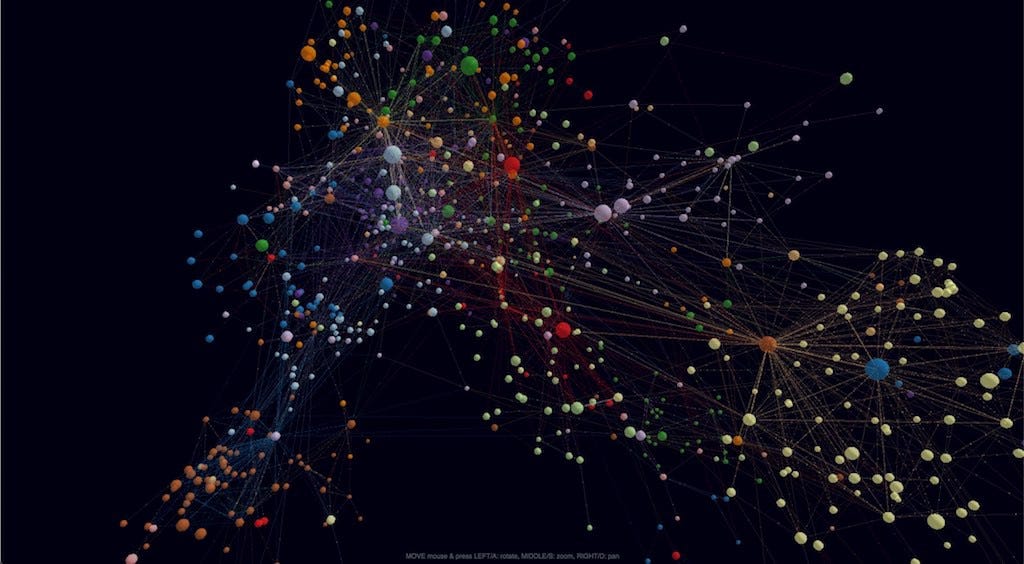
The above model has been implemented in the Aqua-Protocol. Where edges are links between revisions of the same Aqua-Tree or they are links between different Aqua-trees. Every data point is either a file, signature, witness or link revision.
The author has developed a cryptographic data accounting system, the Aqua Protocol (https://aqua-protocol.org), initiated with a smart contract deployment on 18th of April 2021 to accelerate general data accounting and propose a standard. The Whitepaper of the first version of the Aqua was published on the 30.12.2021.
Different teams have built prototypes with the Aqua-Protocol to show its applicability for identity, access control and trust in e.g. signed documents.
If you want to follow our work: https://inblock.io and https://github.com/inblockio or subscribe to my Substack.
I express my sincere gratitude to Professor Ben Koo for his valuable insights and perspectives, which have significantly shaped my understanding of data accounting and the Aqua-Protocol during our collaboration 2021 in Indonesia.
My gratitude also extends to @rht and Amber Case for reviews and feedback.
References
Haber, S., & Stornetta, W. S. (1991). How to time-stamp a digital document. Journal of Cryptology, 3(2), 99–111. https://doi.org/10.1007/BF00196791
Harper, D. (n.d.). Account. In Online Etymology Dictionary. Retrieved from https://www.etymonline.com/word/account
Nakamoto, S. (2008). Bitcoin: A peer-to-peer electronic cash system. Retrieved from https://bitcoin.org/bitcoin.pdf
Todd, P. (2012). OpenTimestamps: Scalable, trust-minimized, distributed timestamping. Retrieved from https://opentimestamps.org/
Buterin, V. (2013). Ethereum white paper: A next-generation smart contract and decentralized application platform. Retrieved from https://ethereum.org/en/whitepaper/
Ethereum (2021) Transaction 0x8da8e400a69b5b2a8ba1e361edec2bd263a96a91b60cd3acdb47dd926507b88d. Retrieved from https://etherscan.io/tx/0x8da8e400a69b5b2a8ba1e361edec2bd263a96a91b60cd3acdb47dd926507b88d
Bansemer T. (2021) Aqua Protocol Whitepaper (Version 1). Retrieved from https://aqua-protocol.org/docs/v1/Protocol/whitepaper
As demonstrated by Surety (1995) based on work from Haber & Stornetta (1991) and since 2012, on Bitcoin with OpenTimestamps (Peter Todd).